Charles VII King of France 1403 - 1461 |
|
|
|
|
Antonin
|
Charles VII |
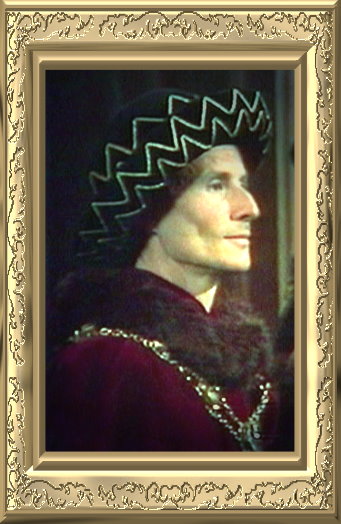

|
Born in Paris 22 Feb. 1403, Charles was the fifth son of Charles VI of France and Isabelle of Bavaria. His four elder brothers — Charles (1386), Charles (1392–1401), Louis (1397–1415) and John (1398–1417) — had each held the title of Dauphin of France, heir to the French throne, in turn; each had died childless, leaving Charles with a rich inheritance of titles, and little else besides.
Almost immediately after his accession to
the title of Dauphin, Charles was forced to face the threat to his inheritance,
being forced to flee Paris in May 1418 after the soldiers of
John the Fearless
Duke of Burgundy
attempted to capture the city. In the following year, Charles attempted to make
a reconciliation between himself and the Duke, meeting him and swearing peace on
a bridge at Pouilly, near Melun, in July 1419. This proving insufficient, the
two met again on 10 September 1419, on the bridge at Montereau. The Duke,
despite previous history, proved over-trusting in his young cousin, assuming the
meeting to be entirely peaceful and diplomatic, and bringing with him only a
small escort; the Dauphin's men reacted to the Duke's arrival, however, by
setting upon him and killing him. Charles's level of involvement remained
questionable ever afterwards: although he claimed to have been unaware of his
men's intentions, it was considered unlikely by those who heard of the murder,
and furthered the feud between the family of Charles VI and the Dukes
of Burgundy.
Charles, unsurprisingly, refused to
allow his nephew to succeed rather than himself, and claimed the title
King of France for
himself; by indecision and a sense of hopelessness, he failed to make
any attempts to throw the English out. Instead, he remained in southern France,
where he was still able to exert some small amount of power, maintaining an
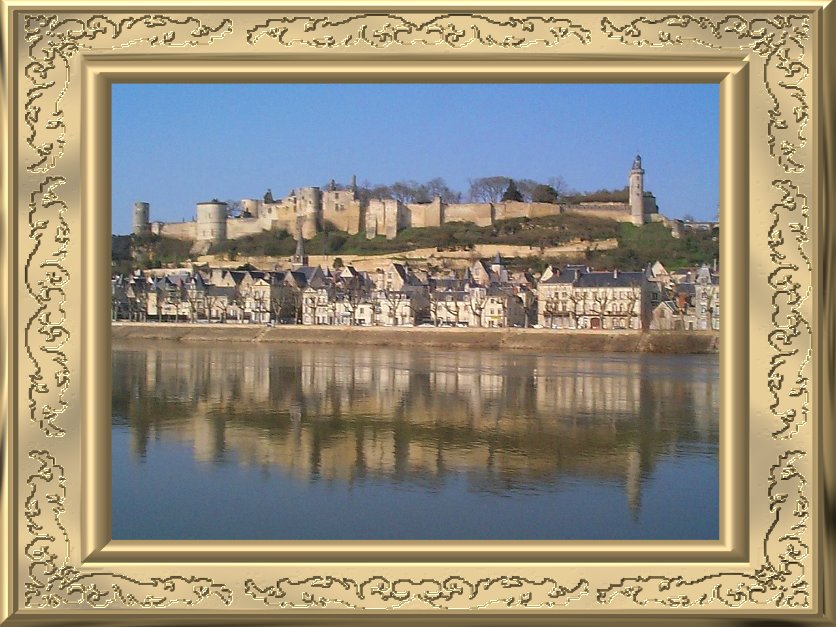
itinerant court in the Loire Valley at castles
such as Chinon being customarily
known as "Dauphin".
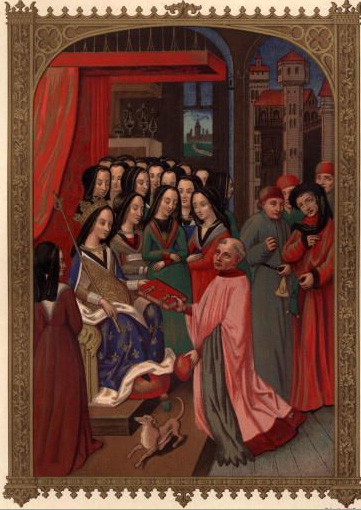
In 1429, however, came a change. Orleans had been under siege since October 1428; the English regent, the Duke of Bedford (uncle of Henry VI) was advancing into the Duchy of Bar, ruled by Charles's brother-in-law, Rene; the French lords and soldiers loyal to Charles were becoming increasingly desperate; and in the little village of Domrémy, on the border between Lorraine and Champagne, a teenage girl named Jeanne D'Arc ("Joan of Arc"), believing she had been given a divine mission by God, demanded of the Duke of Lorraine the soldiers and resources necessary to bring her to Chinon, and the Dauphin. Granted an escort of five veteran soldiers and a letter of referral to Charles by the governor of Vaucouleurs, Robert Baudricourt, Jeanne rode to Chinon, where Charles was in residence, arriving there on 10 March. What followed would later pass into legend. When Jeanne arrived at Chinon, Charles—testing Jeanne's claim to recognize him despite having never seen him—disguised himself as one of his courtiers, and stood in their midst when Jeanne (who was herself dressed in men's clothing) entered the chamber. Jeanne, immediately identifying him, bowed low to him and embraced his knees, declaring "God give you a happy life, sweet King!" Despite attempts to claim that another man was in fact the King, Charles was eventually forced to admit that he was indeed such. Thereafter Jeanne referred to him as "Dauphin" or "Gentle Dauphin" until he was crowned in Reims four months later. One of the important facts that aided in the ultimate success of Charles VII was the support from the powerful and wealthy family of his wife Marie d'Anjou (1404–63), particularly his mother-in-law the Queen Yolande of Aragon. Despite whatever affection he had for his wife, the great love of Charles VII's life was his mistress, Agnés Sorel. After the French won the
Battle of Patay, Charles
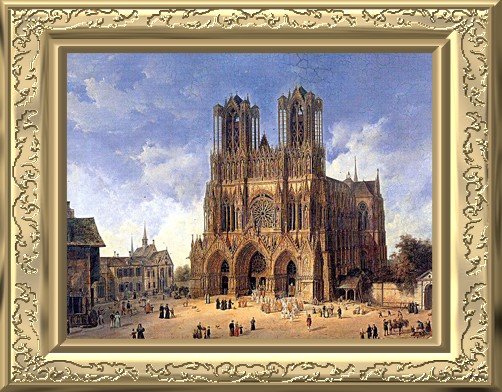
was crowned King Charles VII of France on 17 July 1429, in
Reims Cathedral. Over the
following two decades, King Charles VII recaptured Paris from the English and
eventually recovered all of France with the exception of the northern port of Calais.
In 1458, Charles became ill: The King summoned his son, the Dauphin, to him from his exile in Burgundy; the Dauphin refused, and employed astrologers to foretell the exact hour of his father's death. Finally, however, there came a point in the July of 1461 when the King's physicians concluded that Charles would not live past August. Ill and weary, the King became delirious, convinced that he was surrounded by traitors loyal only to his son; under the pressure of sickness and fever, the King went mad. By now another infection in his jaw had caused a tumour in his mouth; the swelling of this became so large that, for the last week of his life, Charles could swallow no food or water. Although he asked the Dauphin to come to his deathbed, Louis refused, instead waiting for his father to die at Avesnes, in Burgundy. Although Charles VII's legacy is far
overshadowed by the deeds and eventual martyrdom of Joan of Arc,
he himself was also responsible for successes unprecedented in the history of
the Kingdom of France. When he died, France was for the first time since the
Carolingian Emperors united under one ruler, and possessed its first standing
army, which in time would yield the powerful gendarme cavalry
companies, notable in the wars of the sixteenth century; he had also established
the University of Poitiers in
1432, and his policies had brought some economic prosperity to his subjects. His
rule as a monarch had at times been marked by indecisiveness and inaction, and
his ending years marked by hostility between himself and his son; nonetheless,
it is to his credit that he left his kingdom in condition better than he had
found it in.
©
2008
- 2023 linda compagnoni walther |